Sterile Packaging Storage: How to Protect Pre-Sterilized Medical Packaging Before Clinical Use
A sterile barrier system (SBS) is only as strong as the last person who touched it. In audit after audit, the failures we see do not happen inside the sterilizer—they happen in the storage room, on the transport cart, or at the moment a pack is opened. This guide covers the environmental, handling, and inventory controls that keep pre-sterilized medical packaging intact from receiving dock to point of use, aligned with the manufacturer Instructions for Use (IFU) and ISO 11607-1:2019 and ISO 11607-2:2019 (International Organization for Standardization).
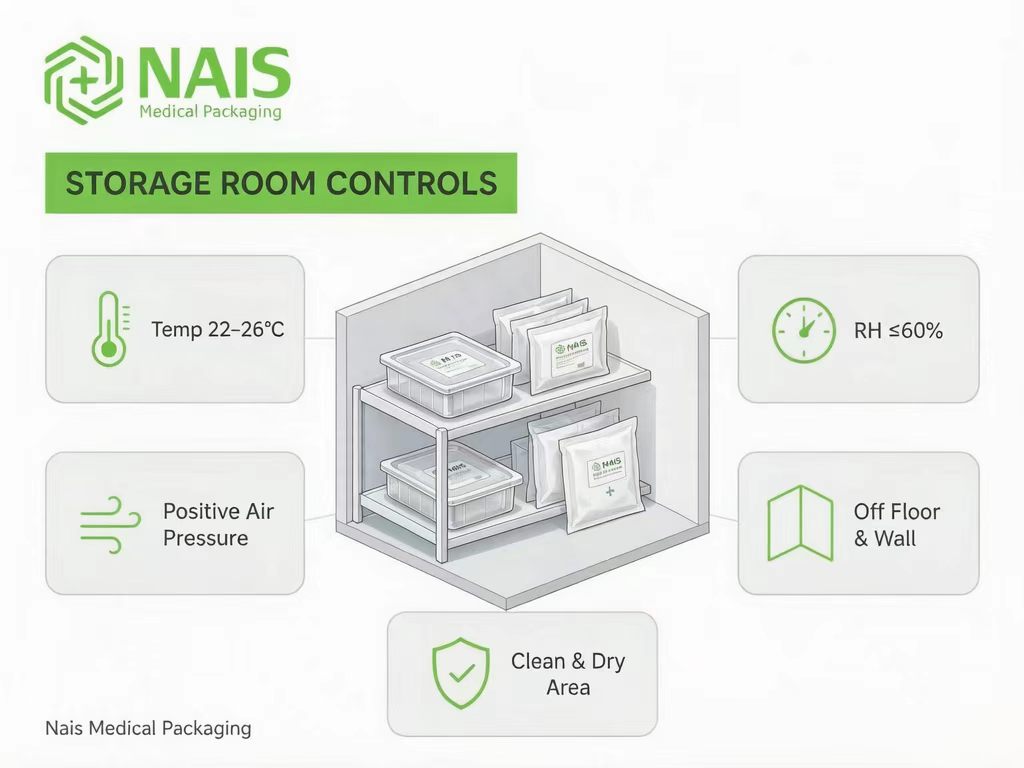
1. Storage Room Specs That Actually Pass Audit
The IFU is the authority. Where the IFU is silent, these are the controls most facilities are expected to demonstrate:
|
Control |
Typical target |
Why it matters |
|
Temperature |
~22–26 °C (72–78 °F) |
Reduces condensation cycling on film and Tyvek lids |
|
Relative humidity |
≤60% RH |
High RH softens paper lids and supports microbial growth |
|
Air pressure |
Positive to adjacent areas |
Stops dirty-air ingress |
|
Air exchanges |
Adequate per facility design |
Dilutes particulates |
|
Clearance |
Off floor, off wall, off ceiling |
Allows cleaning and inspection |
Real-world fail:A room reading 55% RH at 09:00 can spike above 70% overnight when the HVAC sets back. Log humidity continuously with an alarm — not once per shift.
Rules that get skipped:
- Never store sterile packs under sinks, near drains, or below water lines.
- Keep the area dry, dust-free, pest-free, condensation-free.
- Shield from direct sun and UV— many polymer films degrade.
- Break down outer shipping cartons outside the sterile storage zone.
2. Handling Rules Techs Forget
Hand hygiene comes first. Wash before touching sterile packaging, wash again after breaking down cartons, and make sure hands are fully dry before contact.
Transport
- Clean or disinfected carts and closed totes only.
- Never carry packs in pockets, in the mouth, or through break/non-clean zones.
- Solid-bottom carts; wire carts shed debris onto lower packs.
Physical stress
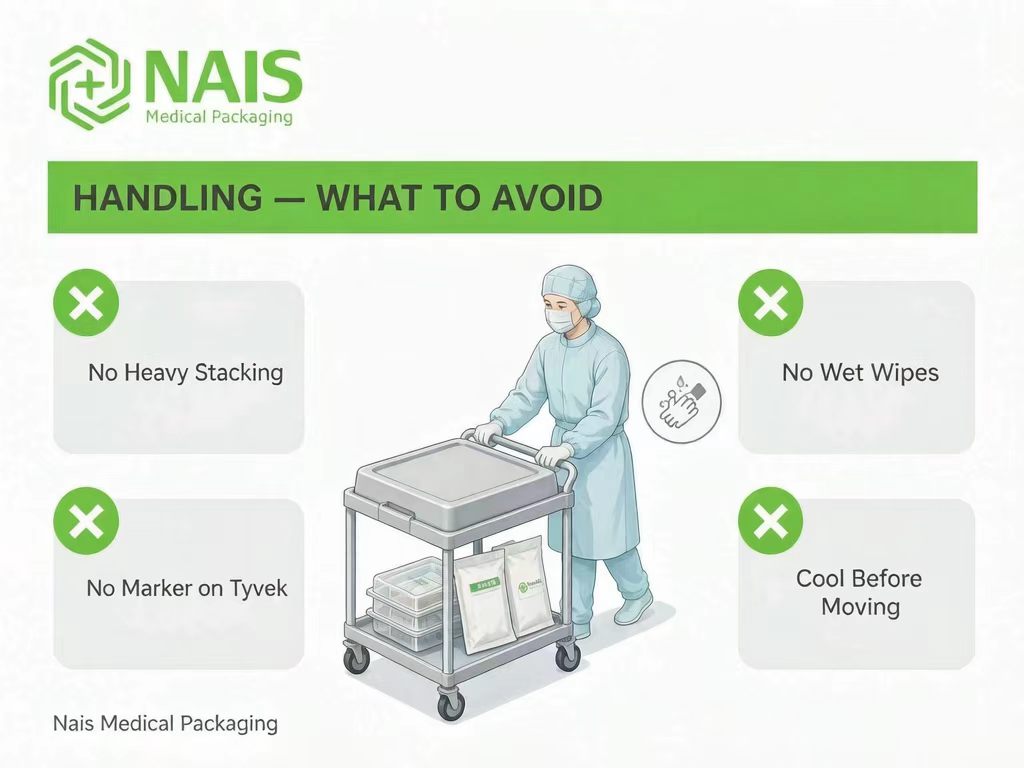
- No heavy items stacked on sterile packs.
- No over-crowding shelves or totes — compression creases seals.
- No rubber bands, clips, or hooks on pouches. They puncture, crease, or stress seals invisibly.
- Let packs cool fully after sterilization before moving or stacking.
Disinfection
- Do not wipe sterile packages with disinfectants unless the IFU explicitly allows it. Liquid and residue can wick through paper lids or attack adhesive.
- Do not write on the Tyvek paper or film face with permanent marker — ink can penetrate.
Real-world fail: A batch of paper/poly pouches sat in a wire basket under a weeping condensate line. Outside looked fine; receiving inspection caught staining on the paper lid. Whole lot quarantined.
3. Inventory Control and the Point-of-Use Gate
Event-related vs date-related sterility
|
Model |
How it works |
Common in |
|
Date-related |
Fixed expiry printed on pack |
Legacy practice; still mandated in some regions |
|
Event-related |
Sterility holds until a compromising event |
US (per AAMI ST79:2017, Association for the Advancement of Medical Instrumentation); spreading in EU |
Under event-related labeling, a pack does not expire—it fails. Drop it, wet it, crush it, breach the seal, and sterility is gone. That distinction is where most errors live.
Rotation discipline
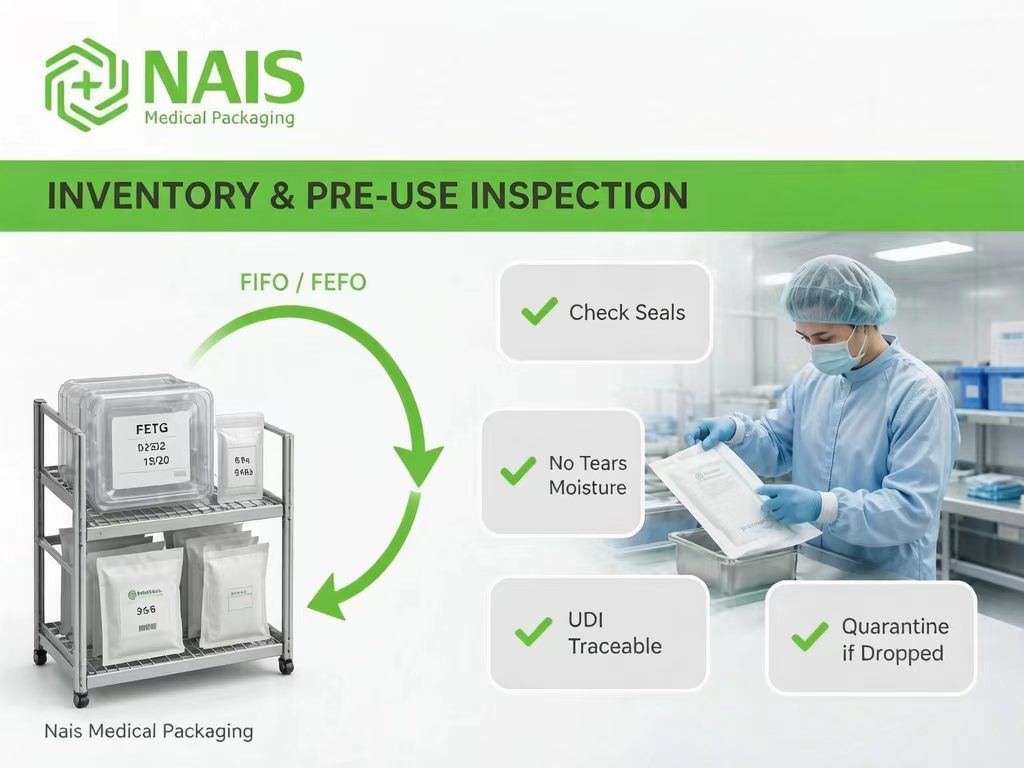
- Run FIFO / FEFO— first in first out; earliest expiry first where dates apply.
- Monitor turnover; pull slow-moving items out of active clinical stock.
- Keep a clearly labeled quarantine zone.
Pre-use inspection—the last gate
Inspect at receiving, during storage, and immediately before opening:
- Tears, punctures, abrasion
- Flattened, creased, or lifting seals
- Moisture, staining, discoloration
- Missing, smudged, or invalid sterility indicator
- Intact lot number and UDI for traceability
Any pack dropped on the floor or an unclean surface, exposed to moisture, or showing damage is compromised. Do not use it. Quarantine and report per facility policy — do not “re-sterilize and return to stock” without documented reprocessing approval.
Real-world fail: A pack dropped during code-cart restock went back on the shelf because “the wrapper looked fine.” A hairline seal crease was not caught until the sterile field was opened.
FAQ
- Can sterile packaging be wiped with alcohol?
Only if the IFU explicitly permits it. Otherwise do not wipe — residue and liquid can compromise paper and film barriers.
- Does event-related sterility mean packs never expire?
No. It means sterility holds until a compromising event. Physical damage, moisture, and rough handling still invalidate the pack.
- How often should storage temp/RH be checked?
Continuously, with alarms. Once-per-shift spot checks miss overnight HVAC setbacks.
- What do I do with a dropped sterile pack?
Treat as compromised. Quarantine and report per facility policy. Do not return to clinical stock.
- Can packs stay in their original shipping cartons?
Not in the sterile storage area. Break outer cartons outside the clean zone to avoid tracking in dust and pests.
Core Takeaway
Sterile barrier integrity is a chain, not a moment. Controlled storage, disciplined handling, and a hard stop at pre-use inspection are what separate a program that passes audit from one that fails a patient.
Need help aligning your packaging to ISO 11607 storage/handling requirements, or drafting an IFU your clinical customers can actually audit against? Talk to our packaging engineering team.
References
Plain text only — no external links, to keep session authority on-site.
- ISO 11607-1:2019 — Packaging for terminally sterilized medical devices — Part 1: Requirements for materials, sterile barrier systems and packaging systems. International Organization for Standardization, 2019. (Confirmed 2024; Amd 1:2023 applies risk management.)
- ISO 11607-2:2019—Packaging for terminally sterilized medical devices— Part 2: Validation requirements for forming, sealing and assembly processes. International Organization for Standardization, 2019. (Confirmed 2024; Amd 1:2023.)
- AAMI ST79:2017—Comprehensive guide to steam sterilization and sterility assurance in health care facilities. Association for the Advancement of Medical Instrumentation, 2017.
- ASTM F1980-21—Standard Guide for Accelerated Aging of Sterile Barrier Systems and Medical Devices. ASTM International, 2021.
- ANSI/AAMI/ISO 11607-1:2019/A1:2023 and ANSI/AAMI/ISO 11607-2:2019/A1:2023 — AAMI-adopted editions of the ISO 11607 series.
- GB/T 19633.1-2015 — 最终灭菌医疗器械包装 第1部分:材料、无菌屏障系统和包装系统的要求 (identical to ISO 11607-1). Standardization Administration of China, 2015. (include only if the page also serves a Chinese-market audience)
What common pitfalls should be avoided when placing bulk orders for custom medical packaging for new medical product launches?