How to Select the Most Suitable Medical Device Packaging Material ?

In my experience, many customers developing medical devices or medical consumables at the R&D stage often face a common challenge: how to determine the most suitable packaging material and its thickness. Material thickness is particularly important because it is closely related to the characteristics of the packaged product, regulatory compliance, and procurement costs.
Let us first review the common medical packaging materials. They can generally be divided into two categories: breathable materials(can be call medical device packaging paper ) and non-breathable or high-barrier materials, including films, thermoformable sheet and medical mounting card.
1. Breathable Materials/medical device packaging paper
Common breathable materials include the following:
- Tyvek® materials, such as 1073B, 1059B and 2S;
- Domestically produced medical dialysis papers, typically available in 60 g/m², 70 g/m² and 80 g/m²;
- French medical papers, also commonly available in 60 g/m², 70 g/m² and 80 g/m²;
- Hypak materials, including H1075B and H1060B;
- Dawnsens materials, including M7001 and M8001.
Hypak and Dawnsens materials are often used as alternatives to Tyvek®. This is because they are also manufactured using the flash-spun process and offer similar high microbial barrier performance, high air permeability and puncture resistance.
2. Non-Breathable
2.1 Laminated Films
Common film structures include:
- PET/CPP;
- PET/PE;
- PA/PE.
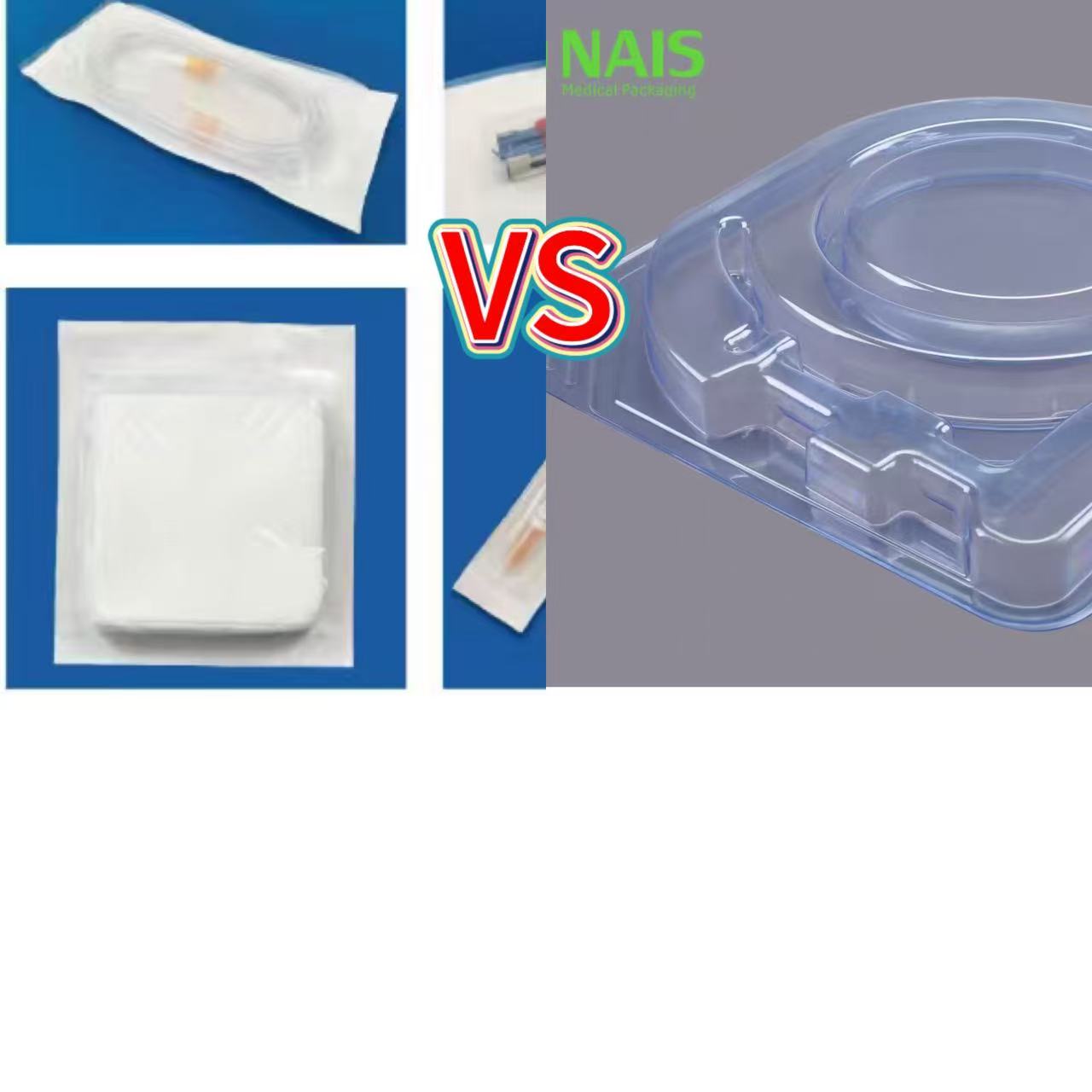
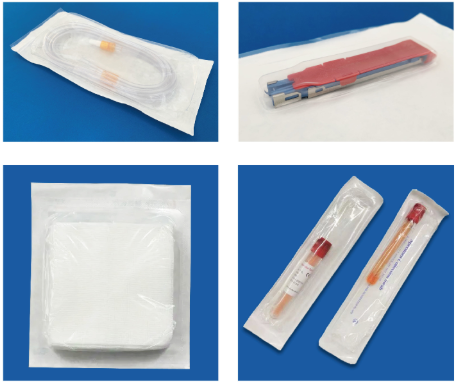
PET/CPP film is often combined with medical paper to produce paper-plastic pouches, which are generally suitable for steam sterilization. PET/PE and PA/PE films are more commonly combined with Tyvek® paper to produce tyvek sterilization pouches.
A special example is the header bag, which typically uses 100-micron PE film combined with coated Tyvek® paper. Among the three common film structures, PA/PE contains nylon, so it is better suited to relatively heavy, irregular products with higher puncture-resistance requirements.
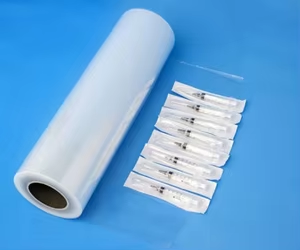
In addition to pre-made pouches made from film and paper, there is also flexible forming film. Flexible forming film generally requires a fully automatic soft-form packaging machine and is suitable for medical consumables produced in very high volumes.
2.2 Aluminum Foil Laminates
Aluminum foil laminates usually have a three- or four-layer structure, such as:
- PET/AL/PE;
- PET/AL/PA/PE.
These structures are suitable for products that require protection against light, oxygen and water vapor, such as surgical sutures.
2.3 Thermoformable Sheets and Medical mounting card
The remaining two high-barrier categories are thermoformable sheets and medical mounting card. Strictly speaking, however, neither of them can be regarded as absolutely non-breathable, because their barrier properties are not as high as those of aluminum foil.
Thermoformable sheets are used to produce thermoformed trays, also known as blister packs/blister trays. They are suitable for Class II and Class III medical devices.
Medical mounting card are mainly used as insert card for products such as catheters and guidewires. They are generally used together with sterile pouches to form a sterile barrier system.
3. Key Factors in Medical Packaging Selection
Selecting the right medical packaging material generally involves the following factors.
|
Medical Product |
Packaging Equipment |
Packaging Characteristics |
Common Sterilization Method |
|
Physical characteristics, including size, shape and weight |
Packaging format |
Style: flexible, semi-rigid or rigid |
EO sterilization |
|
Required protection, such as resistance to water, oxygen and light |
Packaging machine |
Sealing method, including heat sealing and peelable sealing |
Steam sterilization |
|
Annual usage |
Equipment investment |
Printed or non-printed |
Radiation sterilization |
In practice, the local environment, packaging compliance with applicable regulations and final packaging validation results must also be considered. These primary packages affect the safety of medical products, the effectiveness and integrity of the sterile barrier, the user experience during opening, and ultimately patient safety.
4. Material Thickness
Material thickness is generally expressed in μm, micron and mm.
100 μm = 100 micron = 0.1 mm
The appropriate thickness is determined by the characteristics of the packaged product, aged transportation simulation, changes in material mechanical properties before and after sterilization, seal strength and other factors. Greater thickness does not necessarily mean better performance. Excessively thick materials may increase material costs and total packaging volume, as well as storage and transportation costs.
5. Final Selection Principle
There is no universally “most suitable” medical packaging material independent of the specific application. The optimal choice must be determined by evaluating the product, sterilization method, packaging equipment, barrier requirements, cost, local regulatory requirements, and final packaging validation results as a complete system.
Tyvek 1073B vs 1059B: How to Actually Choose the Right One