Flexible Forming Film vs Rigid Thermoform Tray: It's Not Just "Soft vs Hard"
Flexible Forming Film vs Rigid Thermoform Tray: What's the Real Difference?
If you work in medical device packaging, you've probably been there. R&D hands you a new product and asks, "Should we go flexible forming film or rigid tray?" If you say "it depends on the budget," they won't be satisfied. But if you say "it depends on device geometry and sterilization method," that's when the real conversation starts.
In the industry, these are usually called Flexible Forming Film Packaging (the flexible variant within a Form-Fill-Seal, or FFS, system) and Rigid Thermoform Tray Packaging. The names already tell half the story—one uses film to form a cavity, the other uses a rigid tray to cradle the device. But when it comes to actual specification, the differences go way beyond "soft and hard."
This article breaks it down across several dimensions, then gives you a practical decision framework.
1. Structure First: What Do They Actually Look Like?
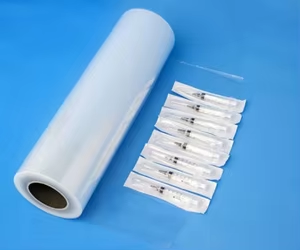
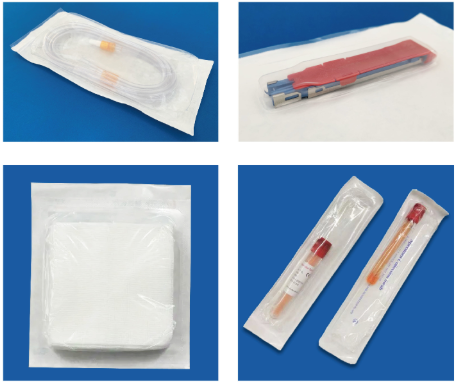
Flexible forming film packaging—technically the flexible variant in an FFS system—uses a breathable bottom web (coated paper or Tyvek®) and a top web of PET/PE or PP/PE composite film. The film is heated and drawn by vacuum into a mold cavity to create a pocket. The device drops in, and the whole thing is heat-sealed to the bottom web. The "shell" is flexible—you can squeeze it. The device has a small amount of play inside.
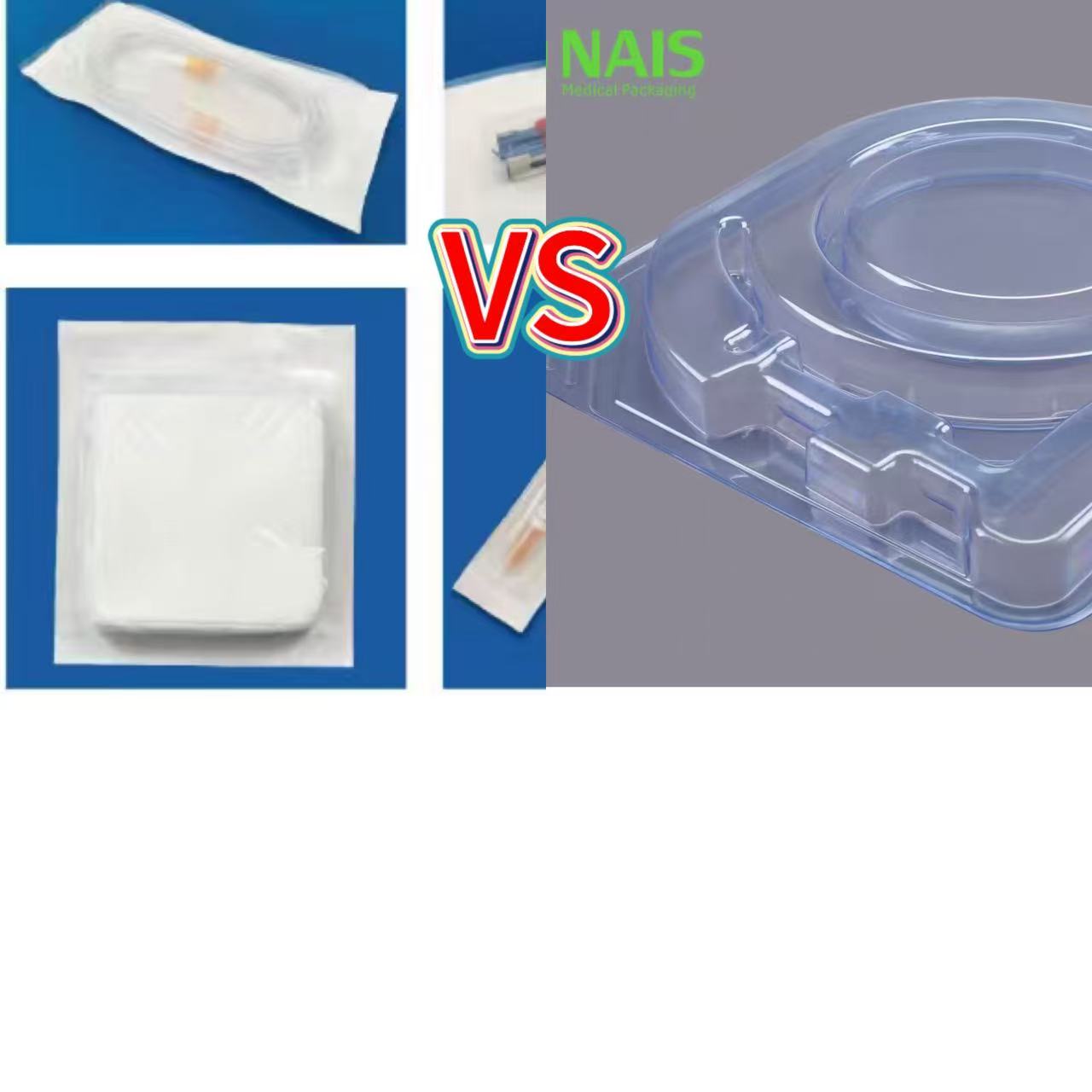
Rigid tray packaging starts with a pre-formed tray (usually PETG, APET, PS or PP) thermoformed from sheet stock, typically 0.5–1.5mm thick. The device sits in molded pockets or clips inside the tray. A lidding material—Tyvek or coated paper or aluminum seal—is heat-sealed on top. The tray is rigid. The device is locked in place with near-zero movement during transit.
Quick rule of thumb: flexible forming film cavities rarely go deeper than 30mm. Beyond that, the film stretches too thin and risks webbing or puncture. Rigid trays can go 50mm deep or more because they're made from thick sheet, not thin film.
2. Material Choice: Film Is "Lean," Tray Is "Safe"
Flexible forming films are typically multi-layer co-extruded or extrusion-laminated structures—common ones include PET/PE, PP/PE, PET/EVOH/PE. The upsides: lower material cost per square meter, fast cycle speeds (a decent FFS line runs 15–40 cycles per minute), and better gauge consistency than thick sheet. The downside: the barrier ceiling is lower. You can't easily build complex multi-layer barrier stacks into thin film. For products extremely sensitive to moisture or oxygen—certain enzyme reagents or high-end implants—flexible film may not be enough.
Rigid trays use sheet materials (PETG, APET, PS,PP) that are inherently stiff and can be specified in heavier gauges. PETG is practically the default in medical packaging—it handles gamma well, has a wide heat-seal window, and has existing DMF coverage with the FDA, which simplifies validation. The trade-off: sheet costs more, tooling is expensive, and after thermoforming, someone still has to load the device and seal the lid. Throughput is lower than FFS.
Here's my take:If you're running over 50,000 units a month, your device is flat, and packaging cost per unit is a major KPI, flexible film is the more pragmatic choice. If the device is high-value (say, a $3,000 surgical instrument set), oddly shaped, and needs to sit "presentation-ready" on the sterile field, the premium for a rigid blister tray is worth every cent.
3. Sterilization Compatibility: Both Need Care, But the Failure Modes Differ
Both formats handle EO, gamma, and steam sterilization. But they fail differently.
For flexible film, the trap is forming-induced thinning. When the film is drawn into the mold, the bottom radius and deep cavity sidewalls stretch. If the design isn't right, the film can turn brittle or even perforate after sterilization—especially steam, with its high heat and humidity. Any packaging engineer specifying flexible film should measure post-form thickness distribution. A widely accepted rule of thumb: the thinnest point at the cavity bottom shouldn't drop below 40% of the original film gauge. That's an experience-based red line in this industry.
For rigid trays, the trap is tray distortion. PETG undergoes slight yellowing and shrinkage after gamma irradiation. If wall thickness is uneven or the tooling has poor venting, the distortion can prevent a clean lid seal. Also, trays seal on a "flat-to-flat" plane. If the flange isn't perfectly flat—mold flash, warpage—seal integrity tests will fail.
One often-overlooked point: because flexible film has some give, if there's residual EO or steam condensation inside after sterilization, the film can bulge slightly to relieve pressure. Rigid trays are a closed rigid system—all internal pressure changes have to be managed through the breathable lidding. That makes blister tray packaging far more sensitive to Tyvek grade selection (1073B vs 1059B).
4. Clinical Usability: What the End User Actually Cares About
A lot of packaging engineers spec based on manufacturing and sterilization, but the end user is the nurse in the OR.
With flexible film, the nurse typically tears the bottom web and pulls the instrument out of the elastic cavity. If the cavity is too tight, the extraction motion could contaminate the device tip. If it's too loose, the instrument rattles around and could puncture the film in transit. Getting this "fit tolerance" right is probably the most experience-dependent part of flexible film design.
Rigid trays usually win on opening experience: peel the Tyvek lids, and the instrument is already sitting in its designated pocket. You carry the whole tray onto the sterile field. Some high-end trays even have "anti-rebound" clips—once the instrument is removed, the tray doesn't spring back and create a recontamination risk. This matters for precision tools in orthopedics or neurosurgery.
But that doesn't mean trays always win. I've seen a case where a laparoscopic instrument was packed in a rigid tray, and the hospital complained it took up too much room on the sterile field—a rigid tray can't be nudged into a corner like a flexible pack can. So the real question is: how does the end user handle this on the table?
5.Cost Model: Don't Just Look at Unit Price
|
Cost Factor |
Flexible Film (FFS) |
Rigid blister Tray |
|---|---|---|
|
Material unit cost |
Low (film by the roll is cheap) |
High (sheet + tooling amortization) |
|
Equipment investment |
High (FFS line: $100K+) |
Medium(thermoformer+ sealer) |
|
Labor |
Low (fully automated inline) |
Medium–High (loading often manual) |
|
Warehousing & freight |
Small roll volume, saves space |
Trays are bulky, higher freight |
|
Validation cost |
Medium (film + paper combo) |
Medium–High (Blister tray + Tyvek lids + retention) |
Counterintuitive fact: at low volumes with many SKUs, rigid trays can actually be cheaper overall. FFS changeover time (mold swap, film threading) is expensive. If you're running a few thousand units per SKU per month, the FFS efficiency advantage never materializes. In that scenario, outsourcing tray forming and doing lidding in-house is often more flexible and cost-effective.
6. Decision Framework: A Practical Selection Tree
When someone asks me "which one," here's the logic I run through:
- Device weight > 500g OR has sharp edges/points? → Rigid tray first (protection + retention)
- Device is flat, weight < 200g, volume > 30K/month? → Flexible film first (cost + throughput)
- Gamma sterilization at > 25kGy? → PETG tray (low yellowing) OR confirm film's EVOH/PA layer won't delaminate
- Clinical requirement: "presentation-ready on opening"? → Rigid tray (pre-positioned)
- Customer extremely sensitive to shipping volume/cost? → Flexible film (compressible, lighter)
If these conditions conflict—say, a heavy device but the customer balks at tray cost—then you're into hybrid territory: thin-gauge tray (0.3mm PET) to cut material cost, or flexible film plus an internal insert card for added protection. That's a whole other conversation.
The Bottom Line
Flexible forming film and rigid trays aren't in a "one replaces the other" relationship. They're two different tools in the medical packaging toolbox. A truly professional packaging partner won't push the solution that happens to fill their own production capacity. They'll ask you three questions first: What does the device look like? How will it be sterilized? How does the nurse use it?
The technical team at Nais Medical Packaging has hands-on project experience with both flexible forming film and rigid thermoform tray systems. If you're stuck on a specification decision, we're happy to run a packaging suitability assessment. Sometimes the answer isn't either/or—it's "prototype in flexible film first, then decide if you need to move to a rigid tray."
About the author: The Nais Medical Packaging technical team has supported hundreds of ISO 13485-certified device manufacturers with sterile barrier solutions. This article is based on real project experience. If you have questions about packaging specification, feel free to discuss in the comments or reach out to our technical team.
Tyvek 1073B vs 1059B: How to Actually Choose the Right One
Automatic Soft Thermoforming Packaging Line: Seven Critical Stages in the Forming Process